AI Built on Anatomical Reasoning
Deep Reasoning combines deep learning with knowledge about anatomical structures, relationships and constraints.
This helps our technology address challenging images and anatomical variation while reducing reliance on large labeled training datasets.
Explore our anatomical modelsFrom Medical Images to Digital Anatomy
Medical Images
The process begins with the image type supported by the selected model, such as CT, CTA or paired X-rays.
Knowledge-Guided Modeling
Deep learning and anatomical reasoning identify, separate and, where supported, label the structures of interest.
Patient-Specific Outputs
The selected model produces a digital representation of the anatomy. Visualizations, centerlines and measurements depend on the model and application.
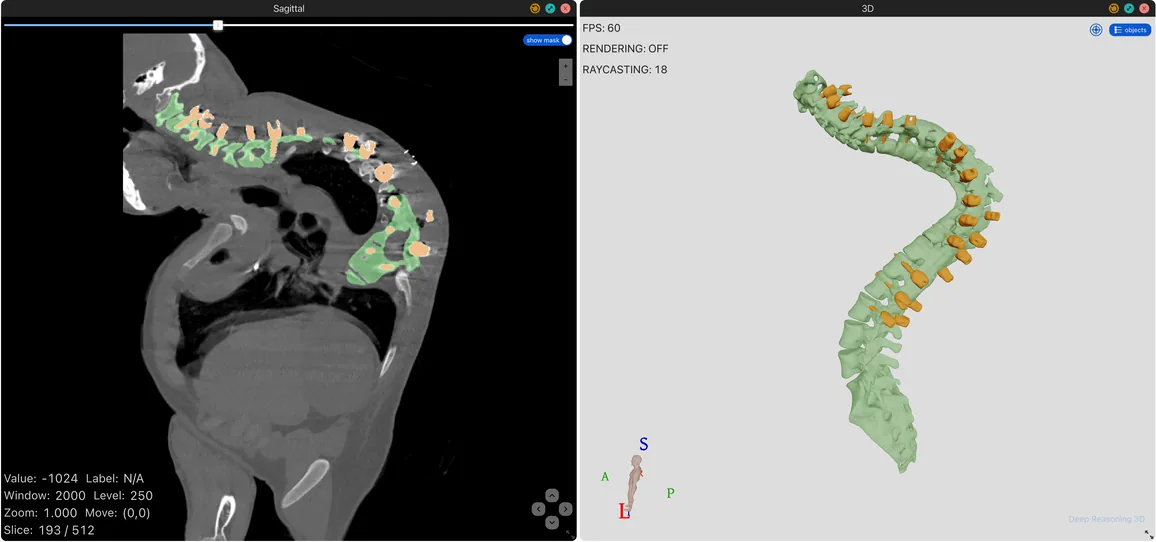
Working with the Complexity of Anatomy
Medical images can include metal implants, imaging artifacts and anatomical variation. Our approach draws on knowledge of anatomical structures and their relationships as part of the modeling process.
From the Model to a Clinical Task
Our 3D models can be used for specific clinical tasks, including exporting measurements and supporting surgical planning.
On a spine model, we can separate the pedicle and the intervertebral disc space to support planning for pedicle screws and other implants.
This figure is one example. Contact us to discuss the anatomy, measurements, and planning tasks for your application.
Contact us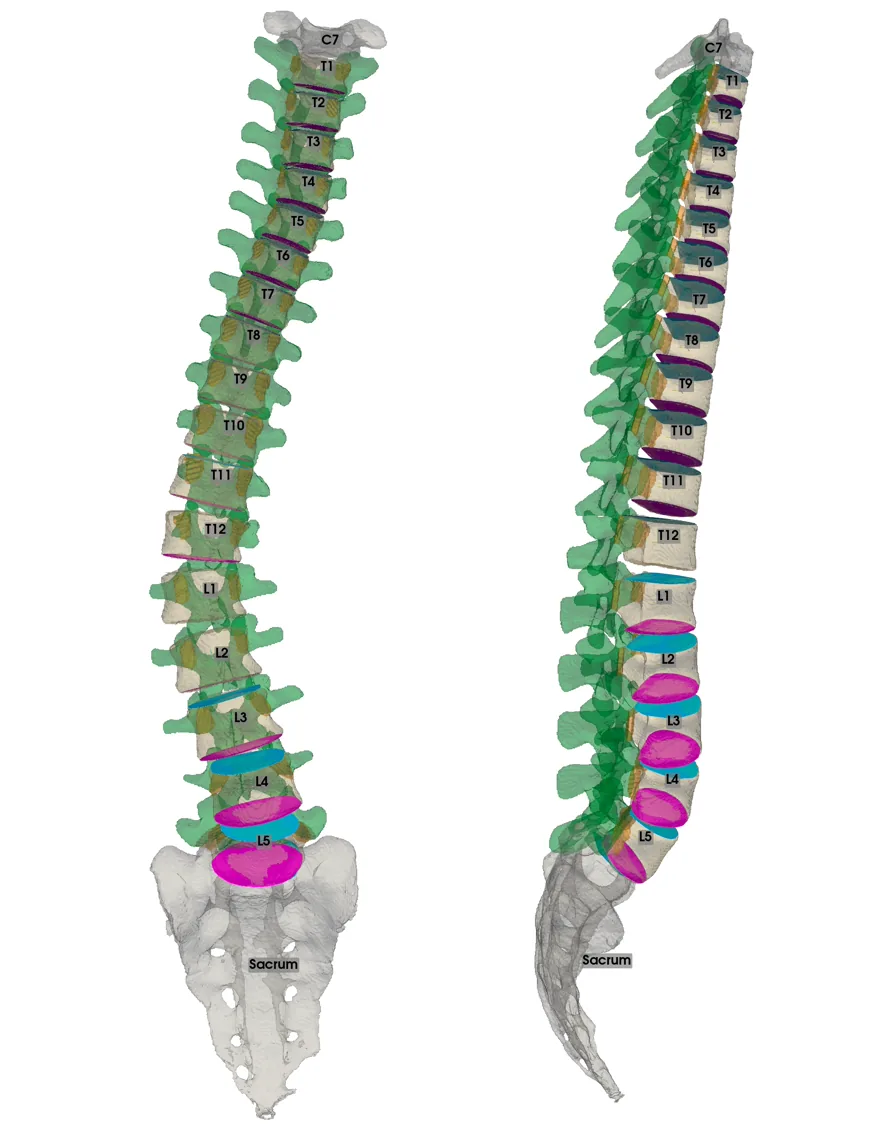
Knowledge Alongside Data
Founded by Bart Selman and Carla Gomes, Deep Reasoning builds on research into how deep learning, reasoning and optimization can work together to solve complex problems.
That foundation supports the development of models across different anatomies using relatively limited labeled training data.
Recognizing patterns in medical images.
Incorporating structures, relationships and constraints.
Using that knowledge within the modeling process.